

Generally speaking, ceramics—especially advanced ceramics—exhibit superior high-temperature performance compared to many other materials. However, among them, there exists a unique class of ceramics that stands out for their exceptional heat resistance, known as Ultra-High Temperature Ceramics (UHTCs). These ceramics are typically synthesized at temperatures exceeding 1400°C, far surpassing conventional ceramics, and can operate in environments often exceeding 1600°C. Remarkably, UHTCs can withstand extreme temperatures up to 2200°C with ease, truly earning their reputation as the “elite of ceramics”.
UHTCs can be primarily classified into several major categories: carbide ceramics, boride ceramics, and nitride ceramics.
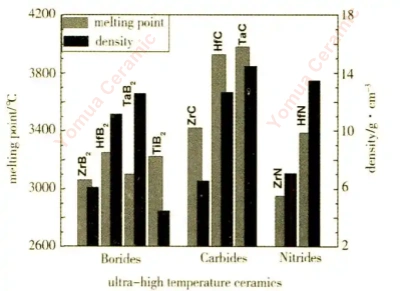
Ultra-High Temperature Oxidation-Resistant Ceramics (UHTORCs) are critical materials for various cutting-edge applications ,including aerospace (e.g., thermal protection systems for hypersonic vehicles, rocket engine nozzles), nuclear energy (e.g., fusion reactor first walls), and the energy industry (e.g., gas turbine blades, high-temperature electrode materials). These ceramics must operate stably in extreme oxidizing environments ranging from 2000°C to 3600°C.
Ultra-high temperature ceramics (UHTCs) can be primarily categorized into several major classes: carbide ceramics, boride ceramics, and Nitride ceramics.
Research Background and Core Challenges
Despite significant advancements, several core challenges persist in the development and application of UHTORCs:
- High-Temperature Oxidation Failure: Traditional ceramics like SiC and ZrB₂ form unstable oxide layers (e.g., SiO₂, B₂O₃) at ultra-high temperatures, leading to rapid spallation and material degradation.
- Thermal Shock Damage: Drastic temperature fluctuations (e.g., a re-entering spacecraft surface rapidly dropping from 3000°C to room temperature) can cause severe cracking.
- Mechanical Property Degradation: At high temperatures, issues like grain boundary softening and accelerated creep lead to a significant reduction in material strength.
Innovations in Material Systems
Current research primarily focuses on the following material systems to overcome these challenges:
1. High-Entropy Ceramics (HECs)
Typical Materials: (Hf, Ta, Zr, W)C or (Hf, Nb, Ti, Zr)B₂
Advantages:
- High-entropy effect slows down elemental diffusion and inhibits the growth of oxide layers (e.g., forming a denser HfO₂-ZrO₂ composite oxide layer).
- High-entropy carbides generally have melting points exceeding 3500°C, with some, like Ta₄HfC₅, reaching as high as 4200°C.
- Case Study: Research from South China University of Technology demonstrated that (Hf₀.₂Zr₀.₂Ta₀.₂Nb₀.₂Ti₀.₂)C exhibited an oxidation rate 1-2 orders of magnitude lower than single carbides at 3600°C under laser oxidation testing.
2. Ultra-High Temperature Borides/Carbides (UHTCs)
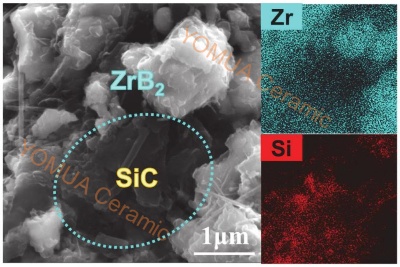
ZrB₂-SiC System:
- Adding SiC promotes the formation of a SiO₂ glassy phase, which can fill cracks in the oxide layer (effective below 1600°C).
- However, above 2200°C, the volatility of SiO₂ leads to a loss of protection.
- Improvement Direction: Incorporating HfB₂ or La₂O₃ to enhance the high-temperature stability of the oxide layer.
3. Layered MAX Phase Ceramics
Ti₃SiC₂ and other MAX phases:
- These materials possess a unique combination of metallic and ceramic properties, forming a self-healing TiO₂-Al₂O₃ layer upon oxidation.
- Limitation: Insufficient high-temperature strength, often exhibiting plastic deformation above 1500°C.
Key Countermeasures and Strategies
Achieving breakthroughs in UHTORCs requires a multifaceted approach:
1. Multi-Scale Structural Design
- Nanocomposite Coatings: Depositing HfC/SiC nanolayer films on ceramic surfaces (e.g., via Chemical Vapor Infiltration – CVI) can effectively slow down oxygen diffusion. For instance, NASA’s HfC-ZrC gradient coating extended the oxidation resistance of carbon-based composites by 5 times at 3000°C.
- Bio-inspired Layered Structures: Designing alternating ZrB₂/SiC layers, similar to nacre, can enhance toughness by deflecting cracks.
2. Optimization of Anti-Oxidation Additives
- Rare Earth Oxides (Y₂O₃, La₂O₃): These additives can refine grain size and form high-melting point rare earth silicates (e.g., Y₂Si₂O₇), effectively blocking oxygen diffusion pathways.
- Carbon Nanotubes (CNTs) Reinforcement: CNTs can improve thermal conductivity, thereby reducing localized thermal stress concentrations.
3. Advanced Preparation Processes
- Reactive Melt Infiltration (RMI): This cost-effective method involves infiltrating porous carbon preforms with silicon melt to produce dense SiC-based composites.
- Spark Plasma Sintering (SPS): SPS enables rapid sintering, suppressing grain growth and improving mechanical properties (e.g., SPS-prepared HfB₂-20vol%SiC achieved a bending strength of 650 MPa).
4. Extreme Environment Testing Techniques
- Laser Heating Oxidation Test Rigs: These platforms simulate transient oxidation at temperatures above 3000°C (e.g., the high-flux testing platform at the Institute of Metal Research, Chinese Academy of Sciences).
- Plasma Wind Tunnel Testing: Used to evaluate material ablation resistance in high-enthalpy gas flows (e.g., China Aerodynamic Research and Development Center’s JF-12 shock wave wind tunnel).
Comparison of UHTORC Material Systems
Future Development Directions
The future of UHTORCs lies in:
- Machine Learning-Assisted Material Design: Utilizing high-throughput computations to screen high-entropy ceramic compositions (e.g., predicting the oxidation kinetics of (Hf, Zr, Ta, Nb)N).
- In-Situ Oxidation Layer Monitoring: Employing techniques like Synchrotron Radiation X-ray Diffraction (SR-XRD) to characterize the evolution of oxide layers in real-time.
- Interdisciplinary Integration: Drawing insights from radiation damage theory in nuclear materials to study defect evolution at ultra-high temperatures.
Conclusion
Breakthroughs in Ultra-High Temperature Oxidation-Resistant Ceramics demand a holistic approach that integrates innovative material compositions (high-entropy, multiphase composites), advanced structural designs (nanoscale, bio-inspired layered), optimized processing techniques (SPS, RMI), and upgraded testing methodologies. While (Hf, Zr, Ta)C-based high-entropy ceramics and ZrB₂-SiC-CNTs systems show promising engineering application potential, large-scale production and long-term service validation remain critical bottlenecks for commercialization.
Resource Sites for Reference
For further in-depth information on Ultra-High Temperature Oxidation-Resistant Ceramics, consider exploring the following resources:
Academic Journals & Publishers:
- Nature Reviews Materials: https://www.nature.com/natrevmats/ – Publishes high-impact reviews, including articles on UHTCs.
- Journal of the American Ceramic Society (JACS): https://ceramics.org/publications-resources/journal-of-the-american-ceramic-society – A leading journal for ceramic science and engineering.
- Materials Science and Engineering: A: https://www.sciencedirect.com/journal/materials-science-and-engineering-a – Focuses on structural materials.
- Progress in Materials Science: https://www.sciencedirect.com/journal/progress-in-materials-science – Publishes comprehensive review articles on advanced materials.
- Journal of Materials Science: https://www.springer.com/journal/10853 – Covers all aspects of materials science and engineering.
- MDPI Materials: https://www.mdpi.com/journal/materials – An open-access journal with special issues often dedicated to UHTCs.
- ACS Publications (American Chemical Society): https://pubs.acs.org/ – Publishes numerous journals covering materials science, including ACS Applied Materials & Interfaces and Chemistry of Materials.
- Elsevier, Springer, Wiley, SAGE Publications: These are major academic publishers whose websites host extensive collections of books and journals on materials science and ceramics. You can typically search their platforms for “Ultra-High Temperature Ceramics” or “UHTCs”.
- Elsevier: https://www.elsevier.com/
- Springer: https://www.springer.com/
- Wiley: https://www.wiley.com/
- SAGE Publications: https://us.sagepub.com/
Research Institutions & Laboratories:
- NASA Ames Research Center (NTRS – NASA Technical Reports Server): https://ntrs.nasa.gov/ – Has a long history of research in thermal protection materials, including UHTCs for aerospace applications.
- Air Force Research Laboratory (AFRL), Materials and Manufacturing Directorate: https://www.afrl.af.mil/AFRL-RX/ – A key U.S. government research arm focusing on advanced materials for defense and aerospace.
- Office of Naval Research (ONR): https://www.nre.navy.mil/ – Funds research in aerospace structures and materials, including UHTCs.
- Sandia National Laboratories: https://www.sandia.gov/ – Involved in developing UHTCs for extreme environments and high-temperature applications.
- Institute of Metal Research, Chinese Academy of Sciences: http://english.imr.cas.cn/ – Known for its advanced materials research, including UHTCs.
- Missouri University of Science and Technology (MS&T), Materials Science and Engineering: https://mse.mst.edu/ – Houses significant research groups in ceramic engineering and UHTCs.
- University of Virginia, Opila Research Group: http://faculty.virginia.edu/OpilaResearchGroup/ – Specializes in advanced high-temperature materials and UHTCs.
- University of Colorado Boulder, Nonequilibrium Gas & Plasma Dynamics Laboratory: https://www.colorado.edu/mechanical/non-equilibrium-gas-plasma-dynamics-laboratory – Conducts research on UHTCs for hypersonic vehicle design.
- Argonne National Laboratory: https://www.anl.gov/ – Involved in advanced materials and manufacturing, including ceramics for extreme environments.
- GE Aerospace Research: https://www.geaerospace.com/aerospace-research – Conducts industry-leading research on advanced propulsion and novel materials for aerospace.
Databases & Software (for research and modeling):
- Thermo-Calc Software: https://www.thermocalc.com/ – Provides thermodynamic and properties databases (e.g., TCUHTM2 database for Ultra-High Temperature Materials), useful for phase diagram calculations and material design.
- ResearchGate: [suspicious link removed] – A platform for researchers to share papers and connect.
- Academia.edu: https://www.academia.edu/ – Another platform for sharing academic research.
- Google Scholar: https://scholar.google.com/ – A comprehensive academic search engine.
- Web of Science / Scopus: Subscription-based academic citation databases. You would typically access these through a university or institutional library.